Project objectives
The overarching goal of the COMPacity project is to establish a demonstration facility in Buffalo City to pilot emission-reduced composting, build practical skills among local stakeholders, reduce greenhouse gas emissions, and prove scalable, economically viable composting models.
In this way, the project is intended to contribute in the long term to improving soil fertility, strengthening climate resilience, and promoting the region's sustainable development.
01

Processing of 1.500 t/a of green waste
The demonstration plant will process 1,500 metric tons of municipal green waste annually into 800 metric tons of high-quality substrate, thereby promoting material recovery and reducing the amount of organic waste sent to landfills.
04

Qualification of 40 trainers
Through a training-of-trainers program, 40 trainers will be certified in low-emission composting methods.
02
CO₂e reduction of 460 tCO₂e/a
Composting 1,500 metric tons of municipal green waste prevents approximately 460 metric tons of CO₂e in greenhouse gas emissions each year.
05
Training of 650 subject-specific students
Through an application-oriented teaching and learning program, 650 students in the fields of sustainability, agriculture, and public administration and business administration are being trained.
03

Improved climate resiliance across an area of 75 hectares
Through a mentoring program for smallholder farmers and the use of compost on farmland, soil structure, humus content, and soil life are being sustainably improved across an area of 75 hectares.
06

Development of a best-practices and transfer guide
Development of a practice-oriented best-practice and transfer guide on the transferability of low-emission composting processes and economically viable composting models to other municipalities and regions.
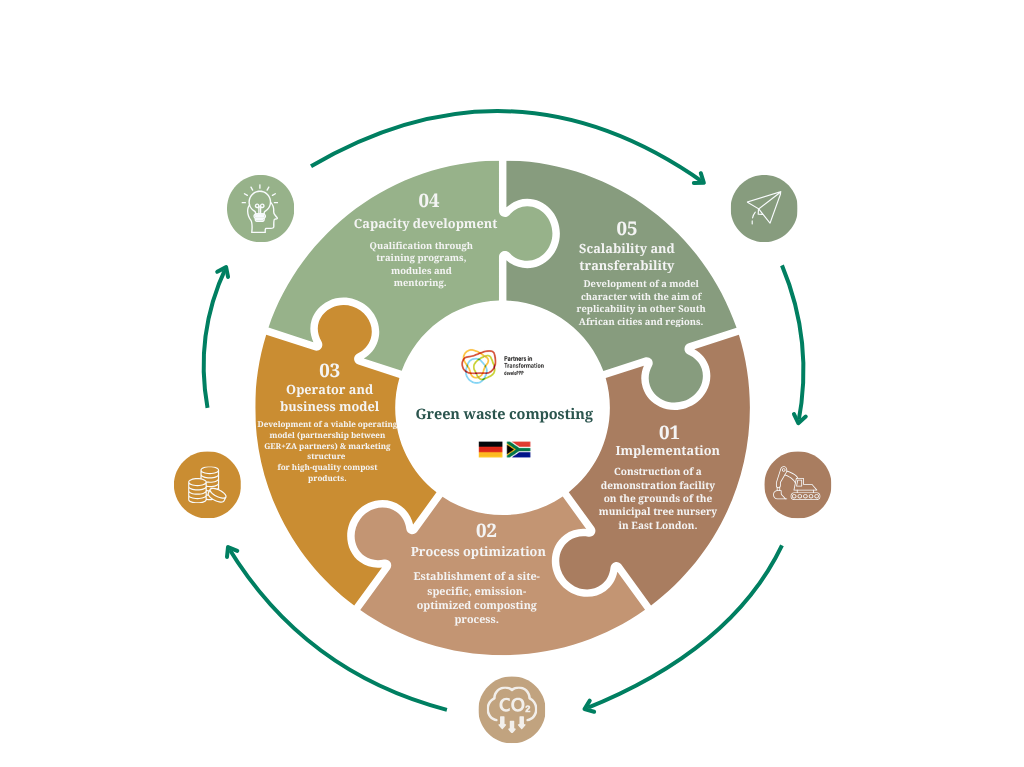
Project components
The individual project components are interlinked and form the foundation for the successful implementation of COMPacity- from the planning and construction of the demonstration facility, through the development of viable business models and training programs, to knowledge transfer and the long-term establishment of a low-emission circular economy in the Eastern Cape region.